Blog

  • Silk vs Grid Cloth: Full, Half and Quarter Explained (2026)

    Silk vs Grid Cloth: Full, Half and Quarter Explained (2026)

    Silk and grid cloth both soften light, but they do it differently. Silk is a light, fine fabric that softens a light while keeping some of its direction, so shadows stay gentle but present. Grid cloth is a heavier woven fabric with a reinforcing grid; it spreads the light more widely for a flatter, more wrapping look, and it stands up better to wind and outdoor use. Full, half and quarter describe how dense the fabric is: full diffuses most and cuts the most light, quarter the least.

    At our store, a 4×4 cloth costs from ₹750 and a 12×12 from ₹3,500. Prices in this guide are from 3 October 2026.
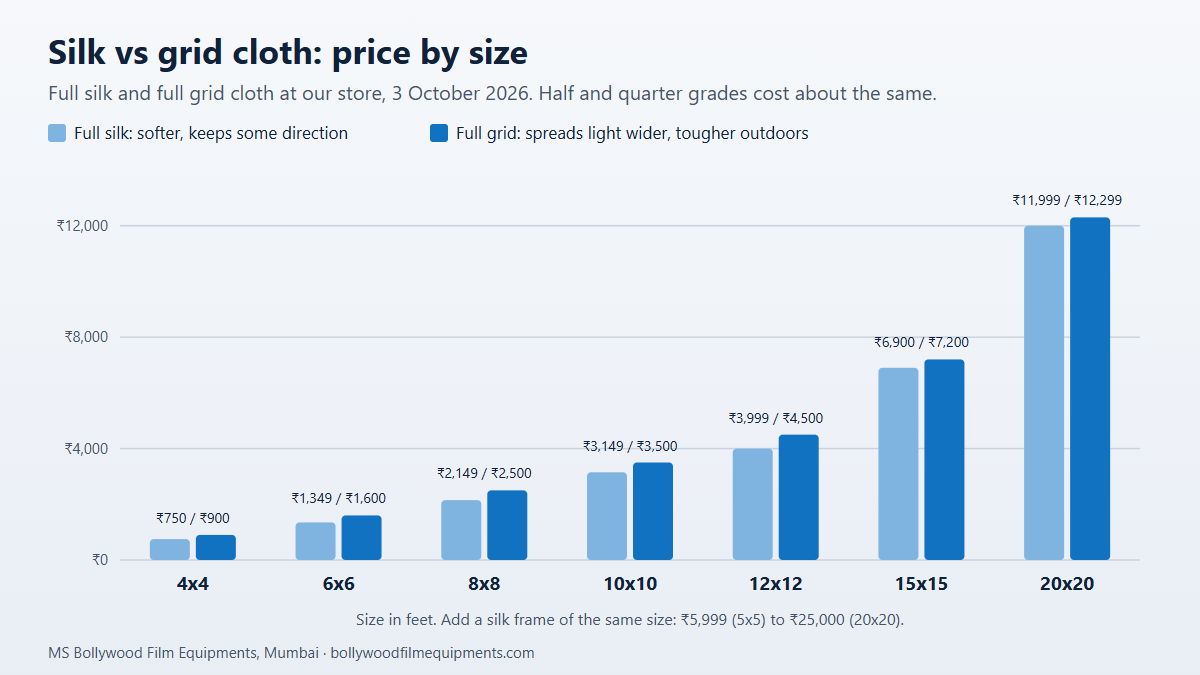
    Bar chart of full silk and full grid diffusion cloth prices in India by size, from 750 and 900 rupees for 4x4 to 11,999 and 12,299 rupees for 20x20
    Full silk and full grid prices at our store on 3 October 2026.

    What is grid cloth?

    Grid cloth is a ripstop-style diffusion fabric: woven with a square grid of heavier threads that stops tears from spreading. It is the diffusion most crews choose for large frames outdoors, because it holds up to wind and handling. Light passing through it spreads widely, so it gives a soft, even, wrapping light. It is also used as a bounce: light aimed at a white grid cloth reflects back as a large, soft source.

    Grid cloth comes in full and half grades at our store. Full grid diffuses more; half grid lets more light through for a lighter softening.

    What is silk diffusion?

    In film lighting, "silk" means a fine diffusion fabric (today usually synthetic, not real silk). It softens and smooths a light but diffuses less broadly than grid cloth, so the light keeps a little more shape and direction. That suits faces and products where you want soft light that still models the subject.

    Silk comes in full, half and quarter at our store. Quarter silk takes the edge off hard light while keeping most of its brightness; full silk gives the strongest softening.

    Silk vs grid cloth at a glance

    Silk Grid cloth
    Fabric Fine, light Heavier woven fabric with a reinforcing grid
    Look Soft, keeps some direction Softer and more spread out, wraps around the subject
    Outdoors Fine in calm conditions Better in wind; more durable
    Also used as – A bounce surface
    Grades at our store Full, half, quarter Full, half
    Light loss (full grade) About one stop, per our listing About one stop, per our listing
    12×12 price at our store ₹3,500 to ₹4,000 ₹4,200 to ₹4,500

    Full, half and quarter: which grade?

    • Quarter silk: the lightest touch. Use it to soften direct sun on a face or take the hardness off an LED without losing much brightness.
    • Half silk / half grid: the everyday choice. Clearly softer light with a moderate loss of brightness.
    • Full silk / full grid: the strongest diffusion, for the softest light, or for cutting harsh midday sun over a whole scene. Our full silk and full grid listings put the light loss at about one stop, so you may need to open the lens or add light.

    If you can only buy one, a half grade in the size of your frame covers the most situations.

    What size do you need?

    Choose the cloth to match your frame, and the frame by what you are lighting:

    • 4×4 and 6×4: one face in a close-up or interview, held on a stand.
    • 6×6 and 8×8: head-and-shoulders and two-person shots; the most common size for small crews.
    • 12×12: a full figure or a group, and the standard size for softening sun outdoors.
    • 15×15 and 20×20: wide shots and large sets. These need heavy stands, sandbags and a crew to fly safely.

    A silk frame holds the cloth flat. At our store, aluminium-and-steel frames run from ₹5,999 (5×5) to ₹25,000 (20×20), with a 12×12 at ₹11,999. See all silk frames.
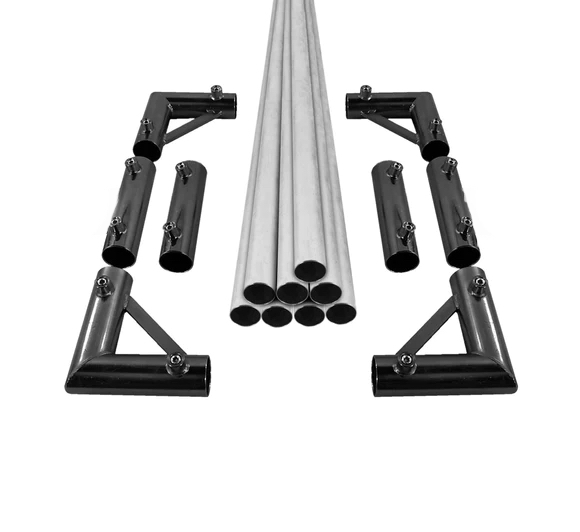
    12'×12' Skimmer Frame (SS & Aluminium)
    A 12×12 silk frame: the standard size for softening sun outdoors.

    Prices by size

    Store prices on 3 October 2026, per cloth:

    Size Full silk Half silk Quarter silk Full grid Half grid
    4×4 ₹750 ₹750 ₹800 ₹900 ₹850
    6×6 ₹1,349 ₹1,300 ₹1,400 ₹1,600 ₹1,450
    8×8 ₹2,149 ₹2,050 ₹2,100 ₹2,500 ₹2,200
    10×10 ₹3,149 ₹3,000 ₹3,100 ₹3,500 ₹3,200
    12×12 ₹3,999 ₹3,500 ₹4,000 ₹4,500 ₹4,200
    15×15 ₹6,900 ₹6,500 ₹6,900 ₹7,200 ₹7,000
    20×20 ₹11,999 ₹11,500 ₹12,000 ₹12,299 ₹12,000

    Each cloth has reinforced edges and corner ties to fit a frame of the same size. Browse the full range of skimmer and diffusion cloth.
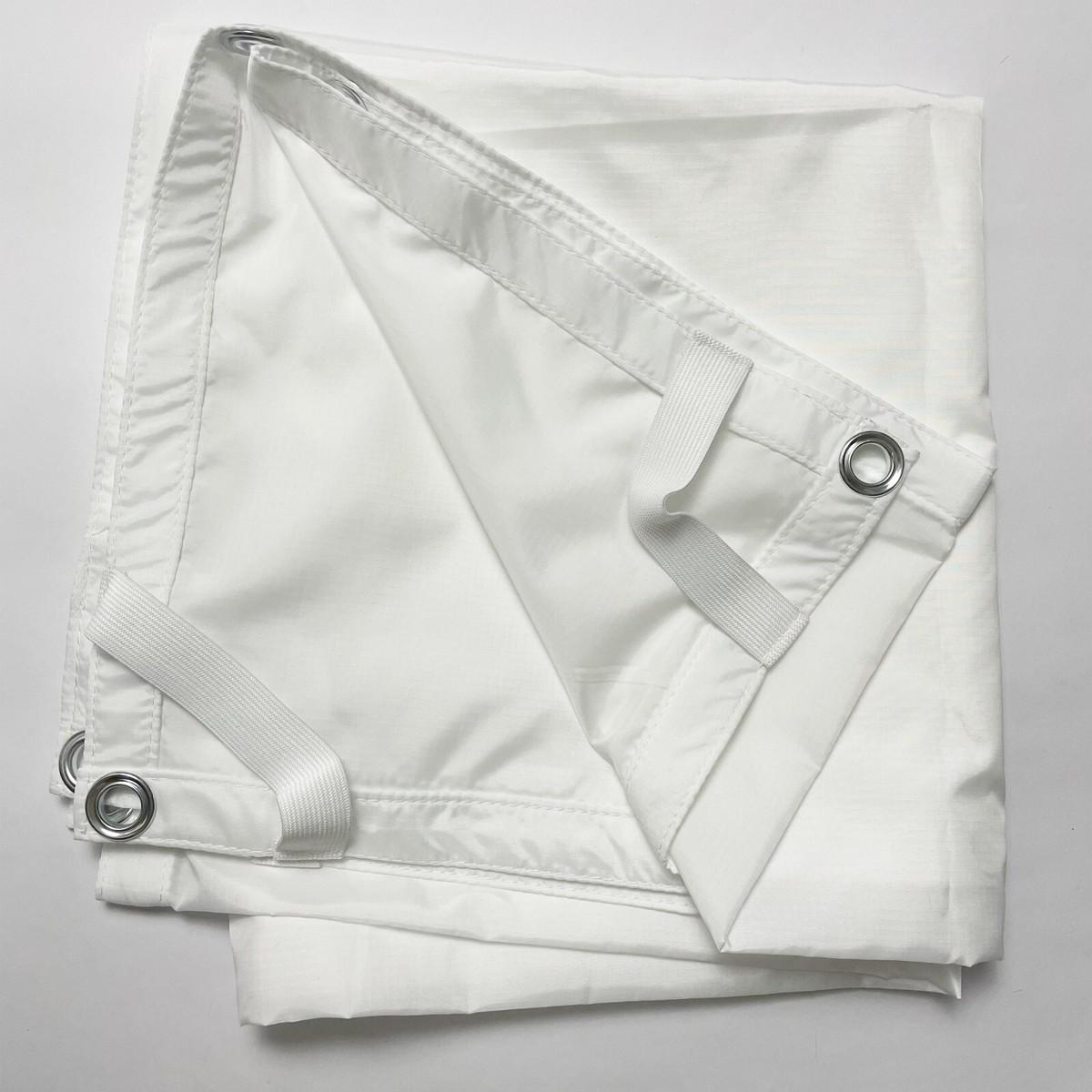
    12’X12′ Half Grid Diffusion Cloth
    Half grid cloth: the everyday grade.

    Silk or grid cloth: which should you buy?

    • Shooting outdoors, often in wind, or using it as a bounce too: grid cloth.
    • Softening a light on faces or products while keeping some shape: silk.
    • Only a light softening of sun or LED: quarter silk.
    • Not sure: half grid in the size of your frame.

    Diffusion cloth works with any light. On an LED, a frame of cloth between light and subject gives a bigger, softer source than a small softbox. See our guide to LED lights for film shooting for lights to pair it with.

    Frequently asked questions

    What is the difference between silk and grid cloth?

    Both are diffusion fabrics that soften light. Silk is finer and keeps some of the light's direction; grid cloth is a heavier woven fabric that spreads light more widely and stands up better to wind and outdoor use. Grid cloth also works as a bounce.

    What does full, half and quarter mean?

    They describe how dense the diffusion is. Full diffuses most and cuts the most light, half is moderate, and quarter is the lightest. Our full silk and full grid listings put the light loss at about one stop.

    What is grid cloth used for?

    Softening sunlight or film lights over a subject, usually on a silk frame, and as a large white bounce. It is the common choice outdoors because it is durable and handles wind better than silk.

    What size silk do I need?

    Match it to your frame and shot: 4×4 or 6×4 for a single face, 6×6 or 8×8 for head-and-shoulders and small crews, 12×12 for a full figure or softening sun outdoors, and 15×15 or 20×20 for wide shots and large sets.

    How much does grid cloth cost in India?

    At our store, full grid cloth costs ₹900 for 4×4, ₹2,500 for 8×8, ₹4,500 for 12×12 and ₹12,299 for 20×20. Half grid costs a little less at each size.
  • LED Lights for Film Shooting: Types, Prices and Which to Buy (2026)

    LED Lights for Film Shooting: Types, Prices and Which to Buy (2026)

    Article 3 – drafted 2026-10-02 (calendar date Nov 3; written early).
    Slug: led-lights-for-film-shooting → /guides/led-lights-for-film-shooting
    Search targets (Ubersuggest India, 2026-10-01/02): led lights for film shooting (320/mo, SD 35) · shooting light (1,600, SD 24) ·
    shooting light price (260, SD 15) · video shooting light setup (260, SD 29). Autocomplete confirms "film shooting light price",
    "film shooting light price in india", "film shooting lights names", "lights for short film shooting".
    Not targeted: "cob light vs panel light" – in India it means home ceiling lights. "video shooting light" (2,900) and
    "continuous light for video" belong to the category pages (keyword map); this piece links to them.
    Prices: store prices on 2026-10-02, all in stock. Quotes prices: recheck monthly with article 2.
    Every spec is from the store's own product data. Not quoted: the Nanlite Forza 150B (its listing carries the FS-300C's description)
    and lux figures where the listing contradicts itself (FS-300B).
    Kits pair only Bowens-mount lights with Bowens-mount modifiers, per the product listings.
    –>


    For film shooting, start with a COB LED monolight as your main light. It's the brightest light for the money, and with a softbox it gives the soft, controllable light most scenes need. At our store a COB monolight starts at ₹20,999 (Godox LA150). Add an LED panel to fill shadows (from ₹8,800) and a tube light for backlight and colour (a two-light Godox TL60 kit is ₹36,800). A complete three-light kit costs from about ₹45,000.

    Prices in this guide are our store prices on 2 October 2026. Below: what each type of light does, what it costs, and three kits at different budgets.

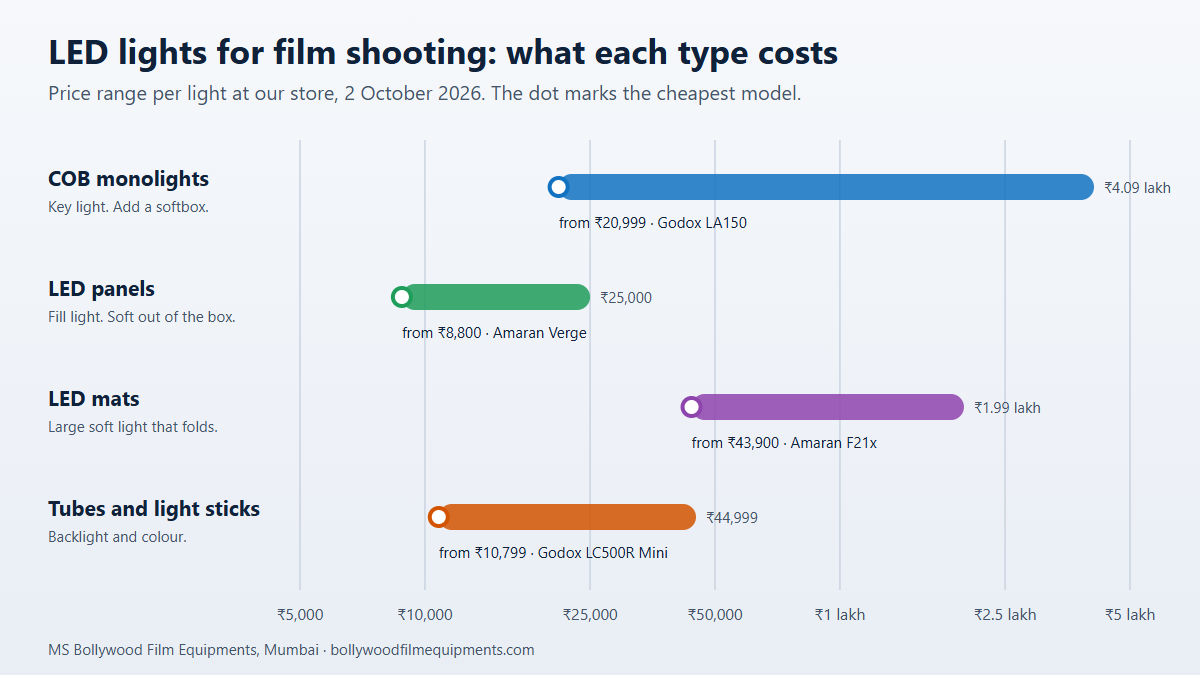
    Chart of LED film light prices in India by type: COB monolights from 20,999 rupees to 4.09 lakh, LED panels 8,800 to 25,000, LED mats 43,900 to 1.99 lakh, tube lights 10,799 to 44,999
    Price per light at our store on 2 October 2026.

    The four types of LED light used on film sets

    Type What it does Use it for Price at our store
    COB monolight One bright point of light; shape it with a softbox or reflector Key light, sunlight through a window, lighting a whole room ₹20,999 to ₹4,09,450
    LED panel Soft, even light from a flat surface Fill light, interviews, small rooms ₹8,800 to ₹25,000
    LED mat A large, very light, flexible soft source Soft key light on location, overhead light, tight spaces ₹43,900 to ₹1,99,000
    Tube light and light stick A long, thin, battery-powered light, usually with RGB colour Backlight, colour in the background, lights hidden in the frame ₹10,799 to ₹44,999 per light

    Most film lighting uses all four. The question is which to buy first, and that is almost always a COB monolight. Browse every type on our film lighting equipment page.

    COB monolights: the main light on most sets

    COB stands for chip on board: hundreds of LEDs packed into one dense chip. Because the light comes from a single small point, a COB light is powerful and throws hard light, like the sun. On its own that light is harsh on faces, so COB monolights take Bowens-mount modifiers. A softbox, lantern or light dome turns them into a large, soft source, and a reflector or fresnel makes the beam punchier.

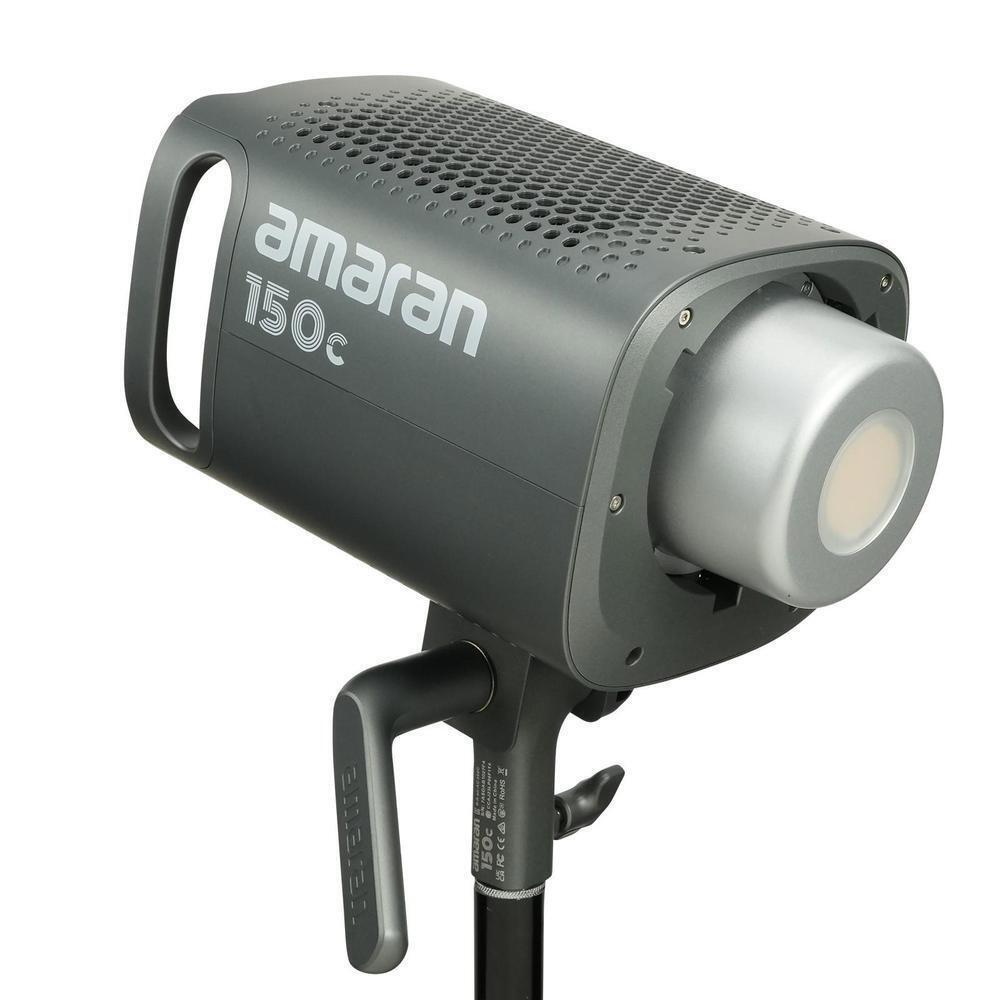
    Amaran 150C RGBWW 150W Full-Color
    Amaran 150c: 150W with full RGB colour and a Bowens mount.

    What to buy:

    • Godox LA150 – ₹20,999. The lowest-cost serious key light we sell: a bi-colour COB (2800K-6500K) with a Bowens mount and app control. The Godox LA200 (₹26,950) is the same idea with more output.
    • Nanlite FS-300B – ₹26,000. A 300W bi-colour monolight with CRI 96 and TLCI 97, for when you need more power than the LA150 at a similar price.
    • Amaran 150c – ₹40,900. 150W with full RGB colour as well as white light (2500K-7500K), and CRI and TLCI of 95+. Choose it if you want coloured light from your main fixture.
    • Aputure LS 300x – ₹1,21,200. A professional 300W bi-colour light with CRI and TLCI of 96+ and app control through Sidus Link.
    • Bigger sets: the Godox KNOWLED M600Bi (₹1,55,000, 730W, runs on two V-mount batteries) and the Aputure STORM 1000c (₹4,09,450) light large spaces or stand in for sunlight.

    A focusing option: the Aputure Light Storm LS 60x (₹54,900) has a beam you can adjust from 15° to 45°. It's weather-resistant (IP54) and runs on NP-F or V-mount batteries, so it works well as a backlight or for a pool of light on location.

    See all continuous lights and softboxes and lanterns.

    LED panels: easy soft light

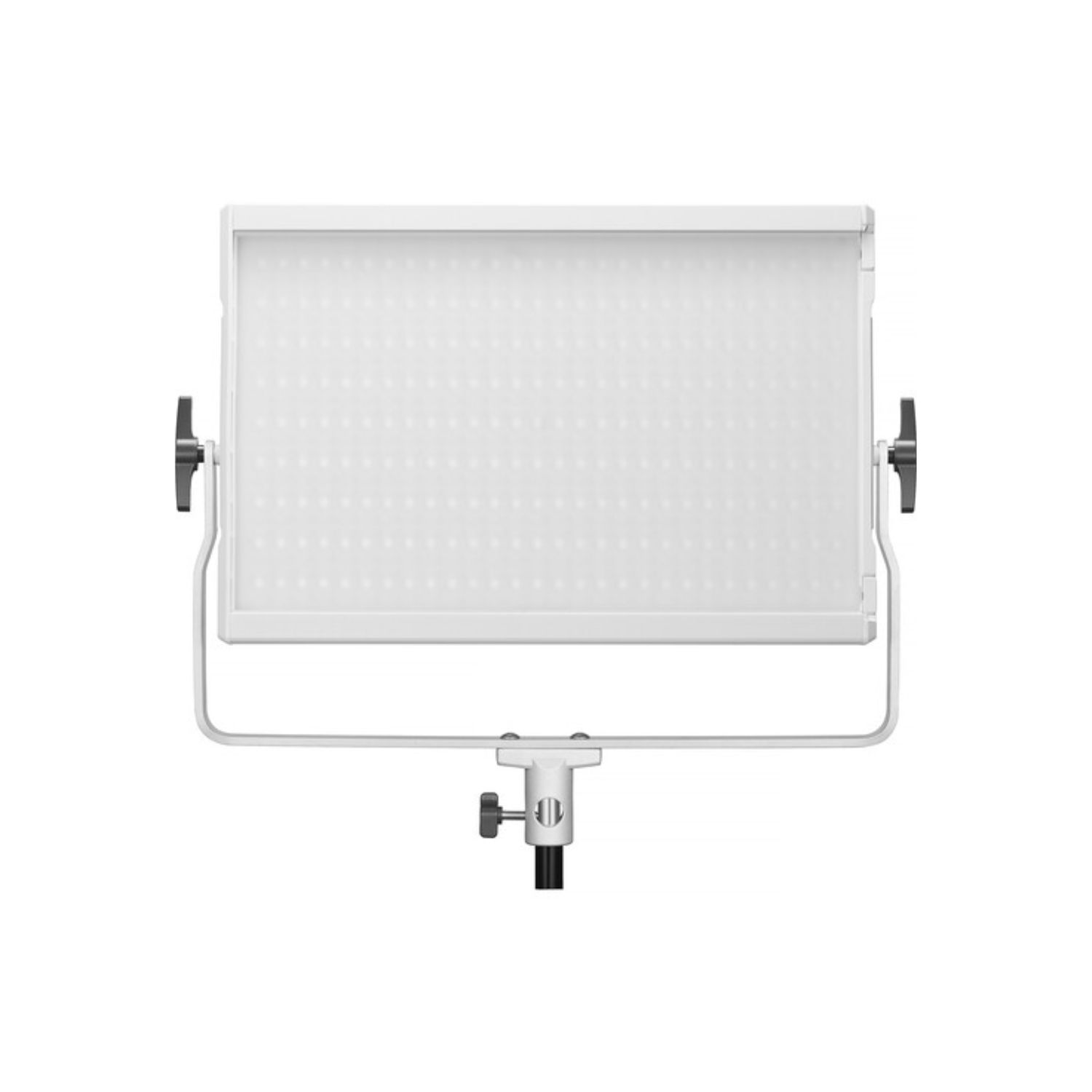
    A panel spreads its LEDs across a flat surface, so the light is soft straight out of the box with no modifier needed. Panels are less powerful than a COB of the same price. That makes them right for fill light, small rooms, and interviews where the light sits close to the subject.

    Godox LP1200 Bi-Color Continuous Light
    Godox LP1200: a 120W panel with a V-mount battery plate and barndoors.
    • Amaran Verge – ₹8,800. A slim 26W edge-lit panel that runs from USB-C power. Good as a small fill light or for a desk setup.
    • Godox LP1200 – ₹17,800. A 120W bi-colour panel with barndoors and a V-mount battery plate. Enough output to be a soft key light in a small room.
    • Amaran Verge Max – ₹25,000. A 60W, 22-inch round panel with CRI 96 and TLCI 98, and silent, fanless running for sound-sensitive shoots.
    • Pocket lights: the Aputure MC (₹12,590) is a palm-sized RGB light with magnets. Use it to light a face in a car or hide behind props.

    More in LED panel lights.

    LED mats: a large soft light that folds away

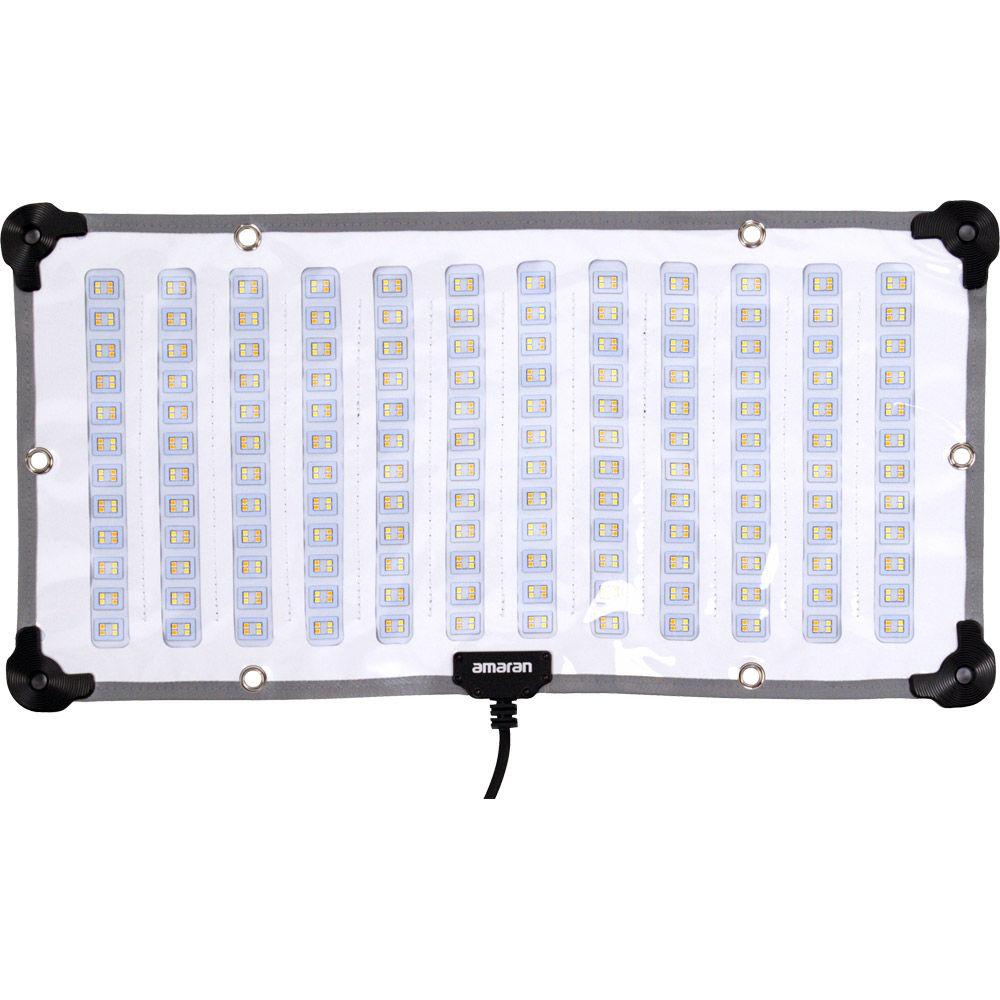
    A mat is a flexible sheet of LEDs. It gives a big, soft source like a large softbox, but it weighs little and rolls up for travel. Mats suit location work where you can't carry heavy lights.

    Amaran F21x Bi-Color LED Mat (V-Mount 2 x 1)
    Amaran F21x: a 100W, 2 x 1 ft bi-colour mat that runs on V-mount batteries.
    • Amaran F21x – ₹43,900. 100W, 2 x 1 ft, bi-colour (2500K-7500K), CRI 95+ and TLCI 98+, and runs on V-mount batteries.
    • Godox KNOWLED F200R – ₹99,000 (2 x 2 ft, RGB) and the F400R (₹1,99,000, 2 x 4 ft) for larger productions.

    Tube lights and light sticks: backlight and colour

    Tubes are long, thin, battery-powered lights, most with full RGB colour. Use them to rim-light a subject, add colour to a background, or place them in the frame as a practical light. Because they run on their own batteries, they can be hidden almost anywhere or taped in place.

    Godox TL60 Tube Light 2-Light Kit
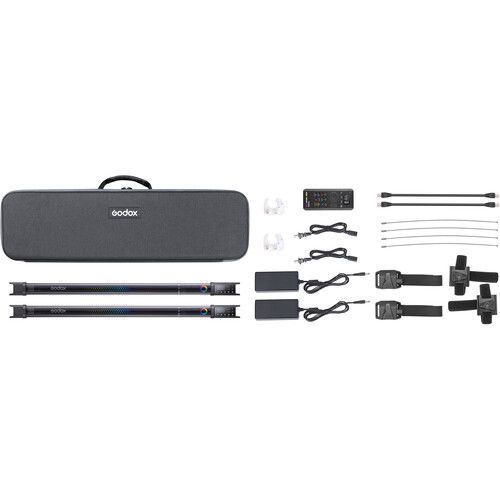
    Godox TL60 two-light kit: each tube has its own battery.
    • Godox LC500R Mini – ₹10,799. A 46cm RGB light stick: the cheapest way to add colour.
    • Godox TL60 two-light kit – ₹36,800. Two tubes, each with a built-in battery that runs for about two hours at full power. A four-light kit is ₹71,800.
    • Godox TL120 – ₹27,599 for a longer single tube, or the TL180 (₹44,999, CRI 96 / TLCI 98) for more output.

    For a wedding-ready version of this kit, see our wedding videography lighting guide.

    What to check before you buy any film light

    • Colour accuracy: CRI and TLCI of 95 or more. Below that, skin tones can look green or grey, and fixing it in the grade takes time.
    • Bi-colour or RGB. Bi-colour lights go from warm (about 2700K) to cool (about 6500K) white, which covers most scenes. RGB adds full colour for music videos and stylised looks, at a higher price.
    • Power. Check whether the light runs on batteries (V-mount or NP-F) as well as mains power. For weddings, outdoor shoots and locations without sockets, this decides what you can use.
    • Mount. A Bowens mount lets a COB light take the widest range of softboxes and reflectors. Check that your modifier matches your light.
    • Output. Compare lux at 1 metre rather than watts. Different brands get different amounts of light from the same power.

    Three lighting kits for film shooting, by budget

    Each kit has a key light with a softbox, a fill light and a backlight. Prices are from our store on 2 October 2026; add light stands to each.

    Starter kit – about ₹44,300

    Short film kit – about ₹88,900

    Professional kit – about ₹2,31,000

    Shooting outdoors? Large diffusion cloth on a silk frame softens sunlight for far less than another light.

    Frequently asked questions

    Which LED light is best for film shooting?

    A COB monolight with a Bowens mount, used with a softbox. It gives the most light for the money and can be made soft or hard. At our store the Godox LA150 (₹20,999) is the starting point and the Aputure LS 300x (₹1,21,200) the professional choice.

    What is the difference between a COB light and an LED panel?

    A COB light packs its LEDs into one bright chip, so it is powerful and needs a softbox to make soft light. A panel spreads its LEDs over a flat surface, so it gives soft light straight away but is less powerful for the price. On a film set the COB is usually the key light and the panel the fill.

    How much does a film shooting light cost in India?

    At our store, a good COB monolight costs ₹20,999 to ₹1,21,200, with larger lights up to ₹4,09,450. LED panels cost ₹8,800 to ₹25,000 and tube lights ₹10,799 to ₹44,999 each. A complete three-light kit starts at about ₹44,300.

    How many lights do I need for a short film?

    Three covers most scenes: a key light, a fill light (or a reflector) and a backlight. Add more lights as you light bigger spaces or want coloured accents in the background.

    Bi-colour or RGB light for film?

    Bi-colour covers most interviews, short films and weddings. Choose RGB when you need coloured light, for music videos, night scenes or a background accent. Many crews buy a bi-colour key light and RGB tubes for colour.

  • Best Camera for Filmmaking Under ₹1 Lakh and ₹2 Lakh in India (2026)

    Best Camera for Filmmaking Under ₹1 Lakh and ₹2 Lakh in India (2026)

    Under ₹1 lakh, the best camera for filmmaking is the Sony ZV-E10 combo: it's the only interchangeable-lens camera at that price that comes with a lens, so you can start shooting the day it arrives. Under ₹2 lakh, the Sony FX30 is the strongest filmmaking camera, with 10-bit recording, S-Log3 and a cooling fan. Choose the A7 IV instead if you also shoot photos and want full frame. One thing to know first: most cameras above ₹1 lakh are sold body only, so budget for a lens.

    We sell Sony, so this guide compares the Sony cameras we stock – see all our Sony cameras. At these prices Canon, Panasonic, Fujifilm and Nikon also make good filmmaking cameras. The checklist below is what to compare, whichever brand you choose.

    What matters in a filmmaking camera on a budget

    • 4K, and 120 fps for slow motion. 4K is standard now. The frame rate is what separates cameras: 120 fps gives smooth slow motion for weddings and music videos.
    • 10-bit recording and a log profile (S-Log3). Ten-bit footage holds far more colour for grading. Without it, heavy colour correction breaks up into bands.
    • Stabilisation in the body (IBIS). Steadier handheld shots without a gimbal.
    • Autofocus that tracks eyes. For a one-person crew, this replaces a focus puller.
    • Recording time. Small cameras can overheat on long takes. A cooling fan solves it.
    • Audio inputs. A microphone jack is the minimum. The built-in mic is for reference only.
    • The whole kit's price. A body-only camera isn't ready to shoot until you add a lens.

    Best cameras for filmmaking under ₹1 lakh

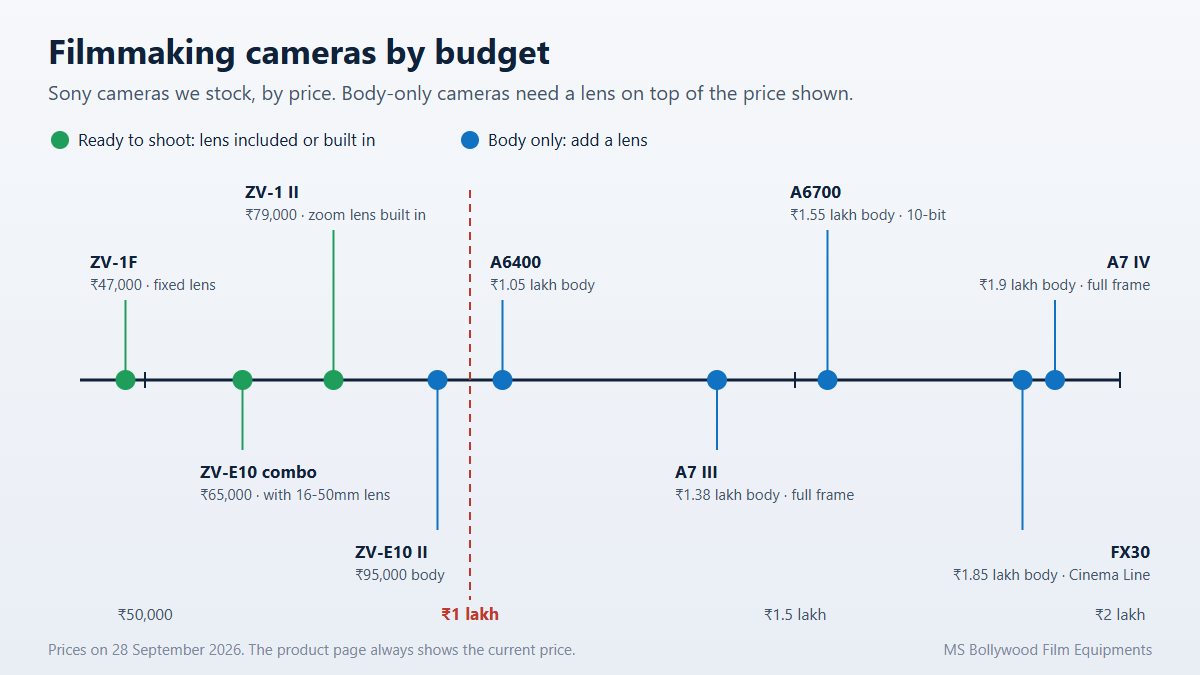
    Camera Price* Ready to shoot? Best for
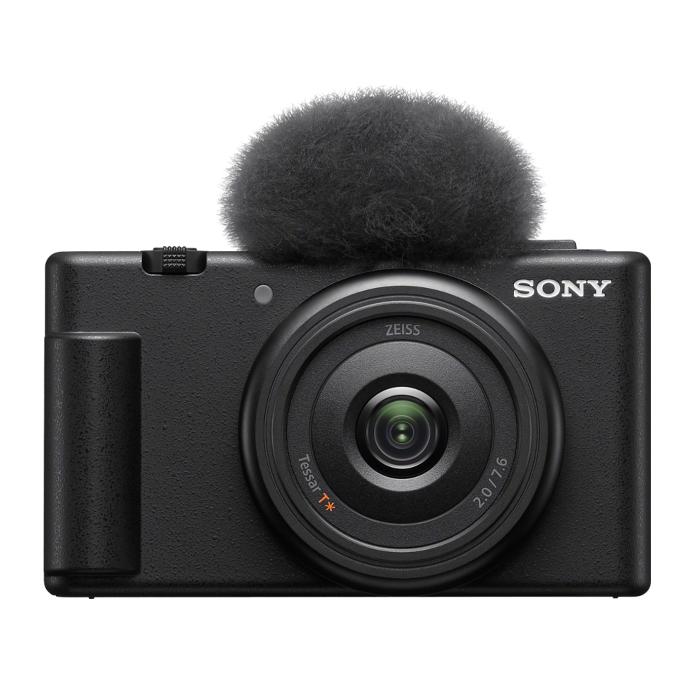
    Sony ZV-1F ₹47,000 Yes, fixed lens First camera, vlogs
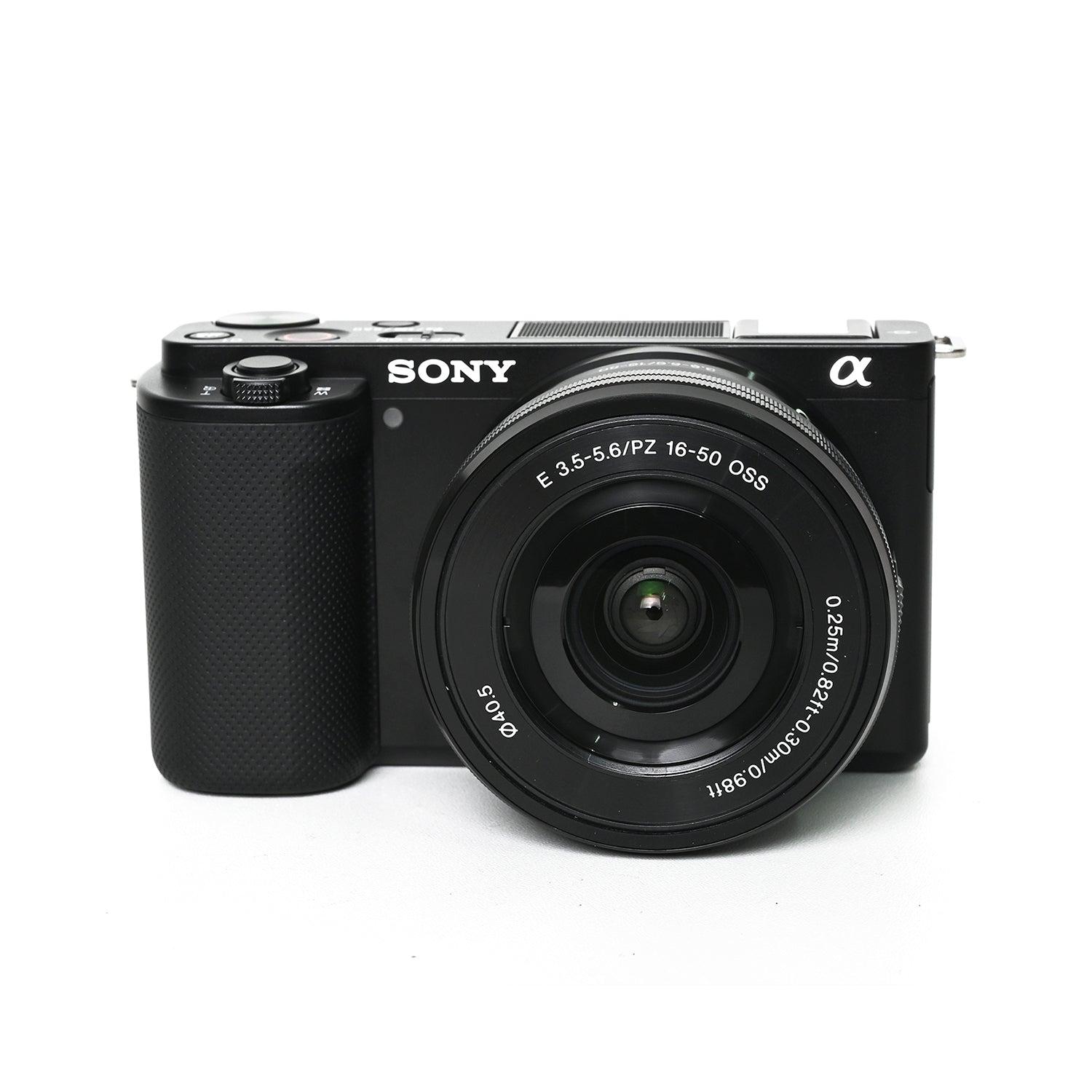
    Sony ZV-E10 combo ₹65,000 Yes, with 16-50mm lens Starting filmmaking with interchangeable lenses
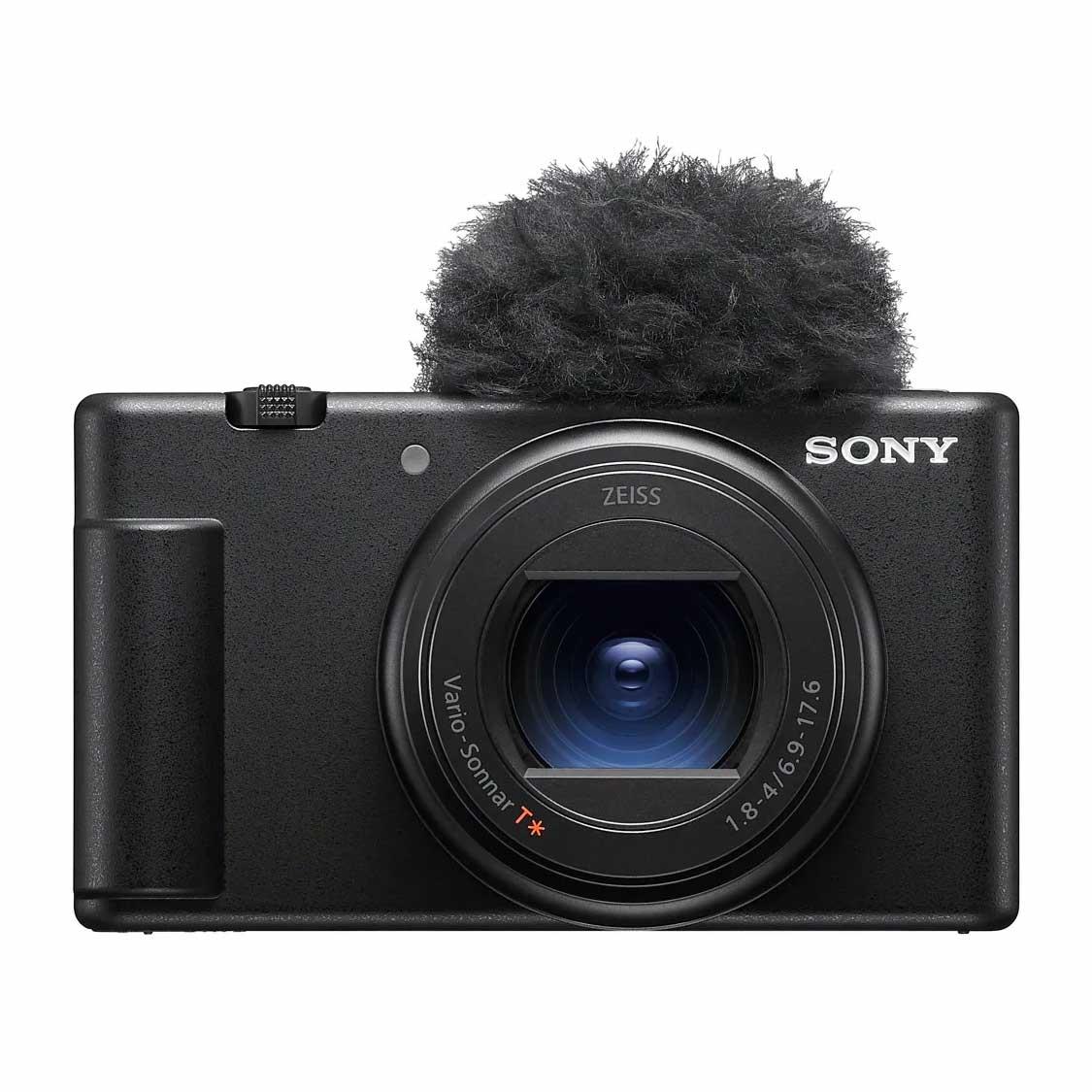
    Sony ZV-1 II ₹79,000 Yes, zoom lens built in Travel, YouTube, run-and-gun
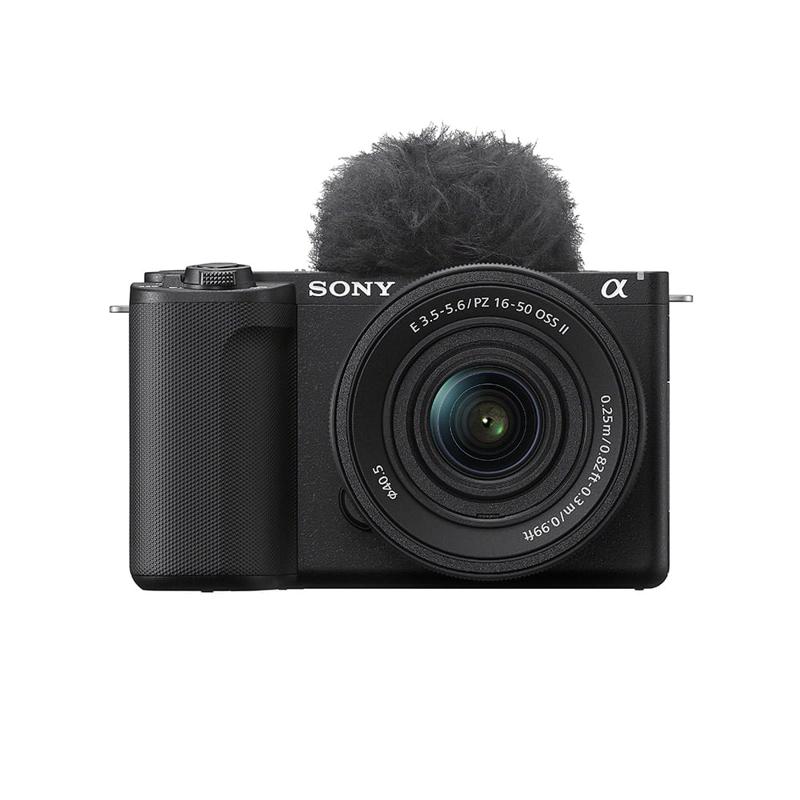
    Sony ZV-E10 II ₹95,000 Body only A newer body, if you can stretch past ₹1 lakh with a lens

    *Prices on 28 September 2026. The product page always shows the current price.

    Sony ZV-E10 combo: the best complete kit under ₹1 lakh

    Sony ZV-E10 Camera Combo

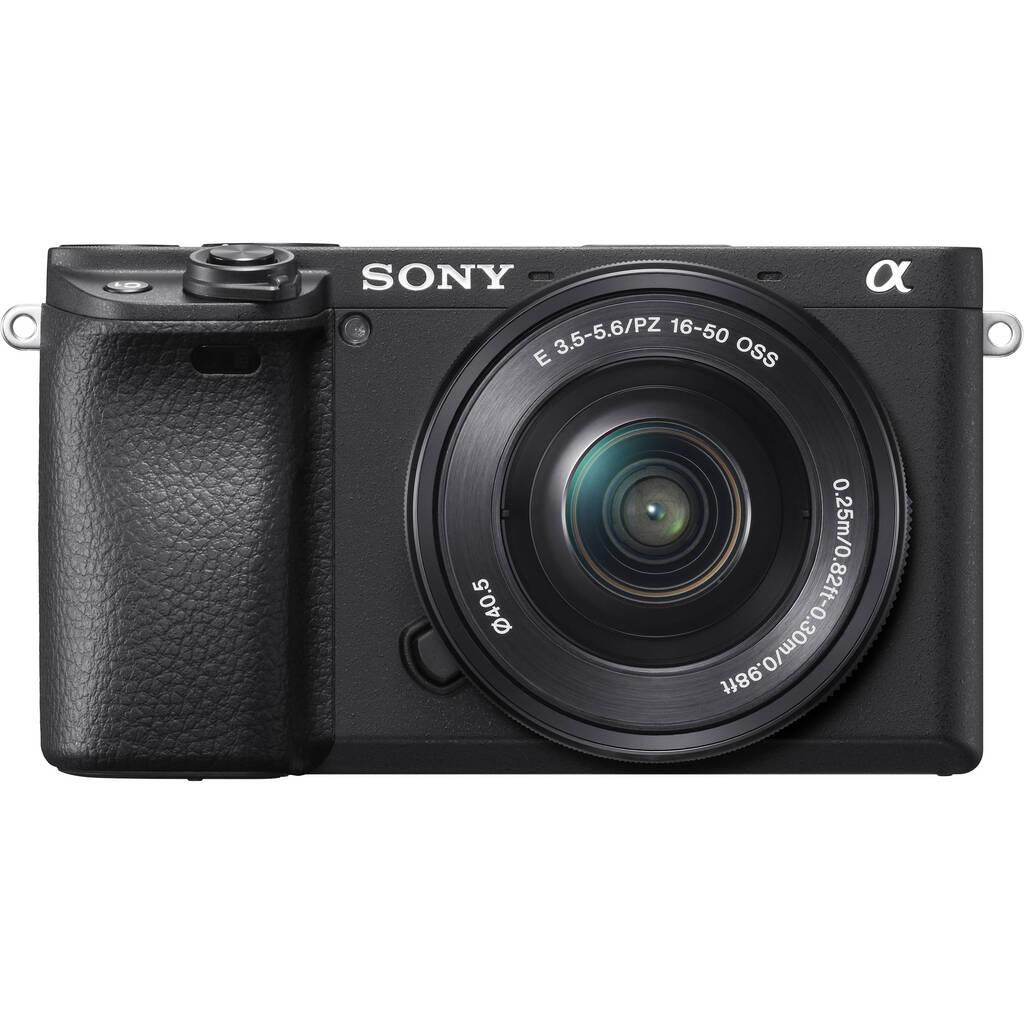
    The ZV-E10 combo pairs a 24.2MP APS-C sensor with the Sony E PZ 16-50mm lens, 4K video, Real-Time Eye AF and a fully articulating screen. Because it uses Sony's E-mount, every lens you buy later also works on the A6700, FX30 and A7 bodies below, so you're buying into a system you can grow with.

    Sony ZV-1 II: the best all-in-one

    Sony ZV-1 II Vlog Camera

    The ZV-1 II has a 1-inch 20.1MP sensor and a ZEISS 18-50mm (equivalent) zoom with a bright f/1.8-4.0 aperture, plus a built-in ND filter for shooting outdoors at the right shutter speed. Nothing to add and nothing to change: good for travel films and YouTube, less so for low light.

    Sony ZV-1F: the lowest-cost way in

    Sony ZV-1F Vlog Camera

    The ZV-1F has the same 1-inch sensor size with a fixed ZEISS 20mm f/2.0 wide lens, 4K and a directional mic with windscreen. There's no zoom, so it suits talking-to-camera and wide shots rather than storytelling.

    Sony ZV-E10 II: the newer body, if you can stretch

    Sony ZV-E10 II Mirrorless Camera
    Shown with a lens; the ZV-E10 II is sold body only.

    The ZV-E10 II moves to a 26MP APS-C sensor and the newer BIONZ XR processor, with 4K up to 60 fps, Full HD up to 120 fps, and both microphone and headphone ports. It's sold body only, so with a lens it lands above ₹1 lakh.

    Best cameras for filmmaking under ₹2 lakh

    Camera Body price* Sensor Why choose it
    Sony A6400 ₹1,05,000 APS-C S-Log3 and a mic input at the lowest price here
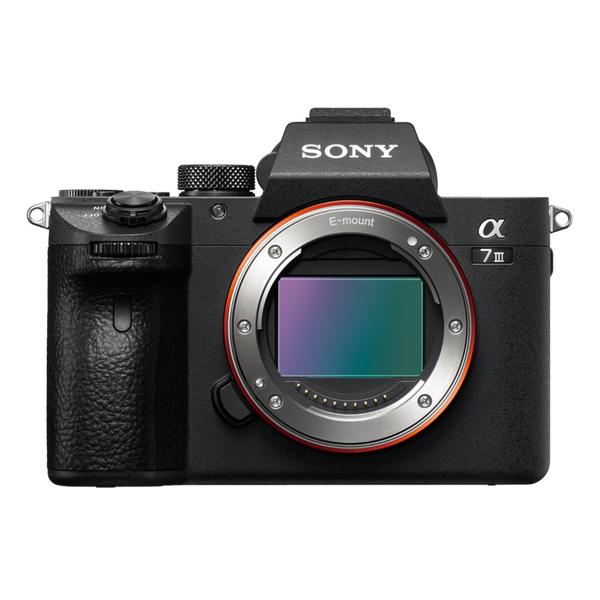
    Sony A7 III ₹1,38,000 Full frame The lowest-cost full frame, with IBIS and two card slots
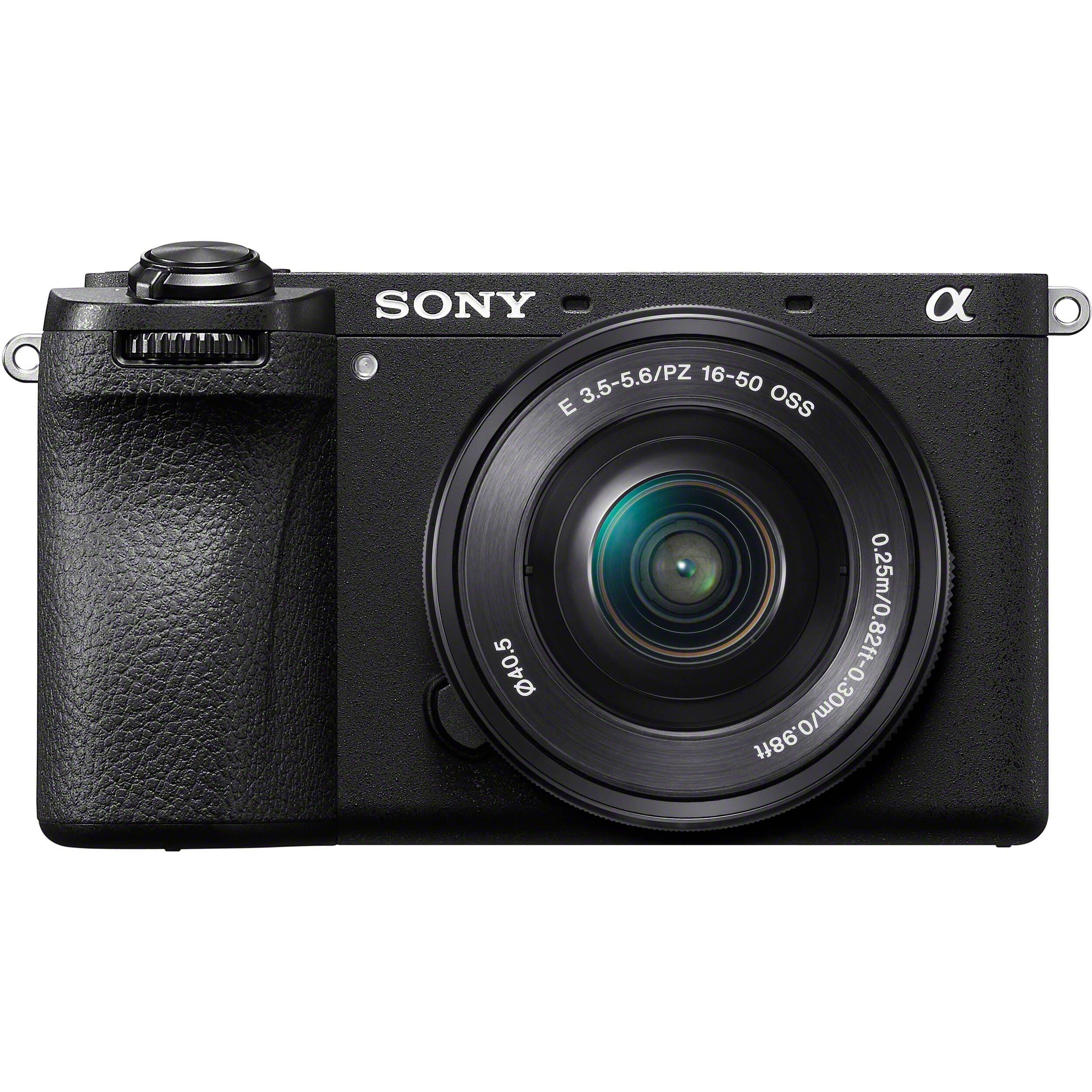
    Sony A6700 ₹1,55,000 APS-C 10-bit, 4K 120 fps and IBIS in a small body
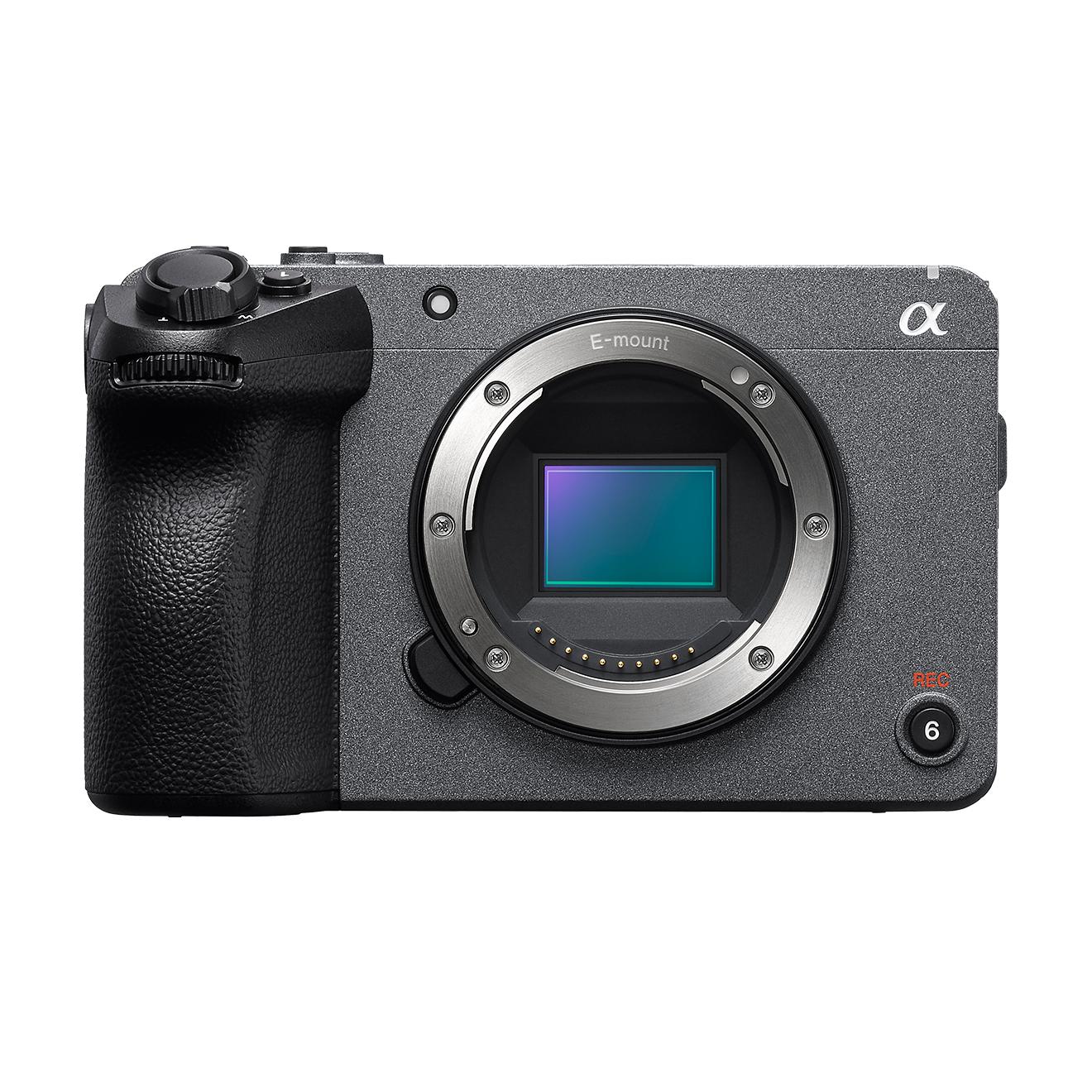
    Sony FX30 ₹1,85,000 Super 35 A true cinema camera: 10-bit, S-Log3, cooling fan
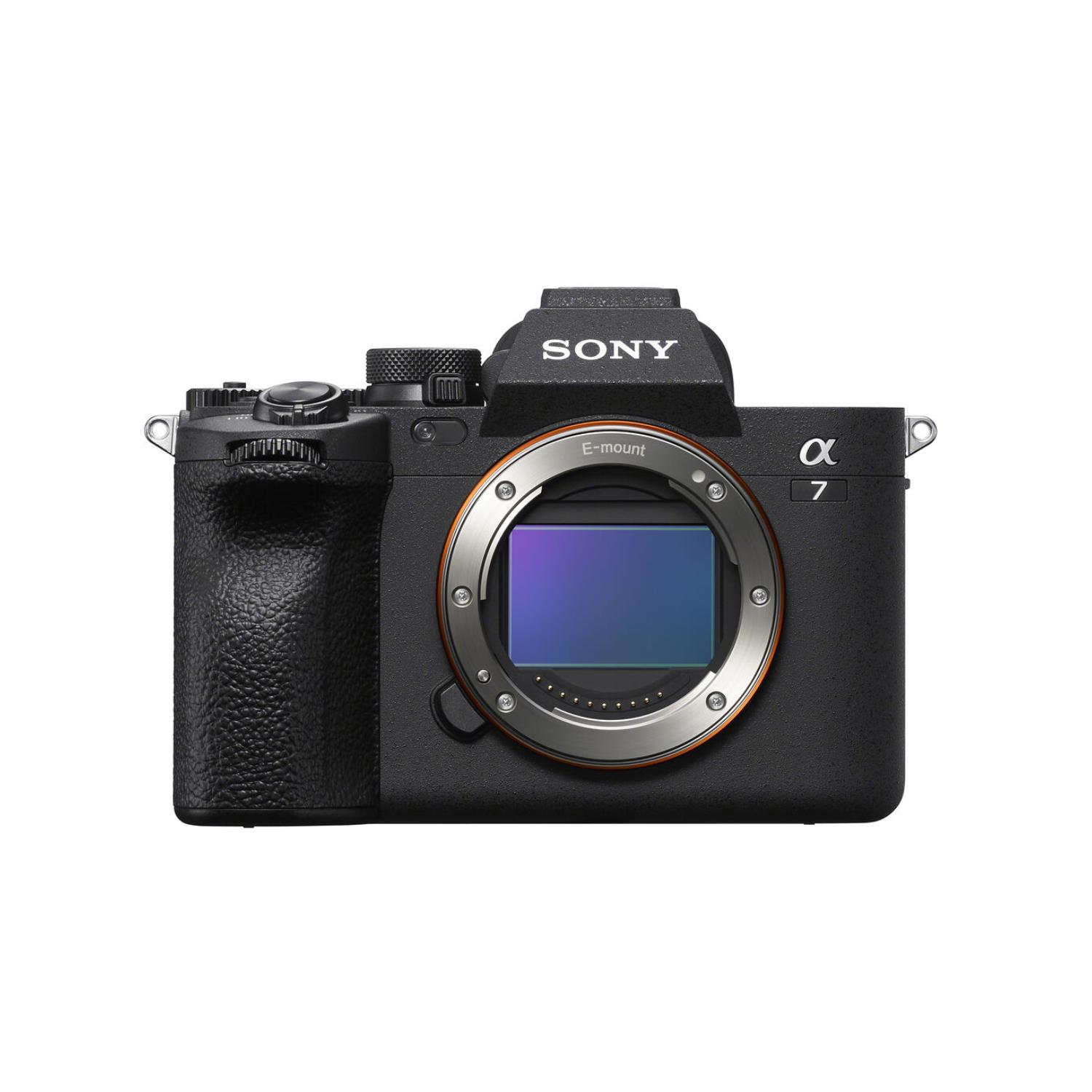
    Sony A7 IV ₹1,90,000 Full frame Film and photos on one body, 33MP

    *Body-only prices on 28 September 2026. Add a lens.

    Sony FX30: the best filmmaking camera under ₹2 lakh

    Sony FX30 Cinema Camera

    The FX30 is part of Sony's Cinema Line. It has a 26MP Super 35 sensor, 4K up to 120 fps, 10-bit 4:2:2 internal recording, S-Log3 with 14+ stops of dynamic range, S-Cinetone colour straight out of camera, dual base ISO for low light, in-body stabilisation, and an active cooling fan for long takes. It's built for video first: the right choice for short films, music videos and client work.

    Sony A7 IV: the best hybrid for film and photos

    Sony Alpha A7IV Mirrorless Camera

    The A7 IV has a 33MP full-frame sensor, 4K up to 60 fps in 10-bit 4:2:2, S-Cinetone and S-Log3, in-body stabilisation, and dual card slots. Full frame gives shallower depth of field and better low light. If you shoot weddings and events where you deliver both photos and video, this is the one.

    Sony A6700: 10-bit and slow motion in a small body

    Sony Alpha A6700 Mirrorless Camera
    Shown with a lens; the A6700 is sold body only.

    The A6700 records 4K up to 120 fps in 10-bit 4:2:2, with in-body stabilisation, AI subject-tracking autofocus, S-Cinetone and S-Log3. Much of the FX30's video quality in a smaller, lighter body, for run-and-gun documentary work.

    Sony A7 III: full frame at the lowest price

    Sony A7M3 (Sony Alpha A7 III) Mirrorless Camera

    The A7 III gives you a 24.2MP full-frame sensor, 4K with full pixel readout, in-body stabilisation and dual SD card slots. It's the older model, so it lacks the 10-bit recording of the A7 IV, but full frame for low-light events at this price is hard to beat.

    Sony A6400: the entry to S-Log

    Sony Alpha A6400 Mirrorless Camera
    Shown with a lens; the A6400 is sold body only.

    The A6400 has a 24.2MP APS-C sensor, 4K, Full HD up to 120 fps, S-Log2 and S-Log3, and a microphone input. It has no in-body stabilisation, so use a stabilised lens or a gimbal.

    Which one should you buy?

    If you mainly shoot Buy
    YouTube and vlogs ZV-1 II, or the ZV-E10 combo if you want to change lenses later
    Weddings and events A7 IV, or the A7 III to save money (full frame for dim halls, two card slots)
    Short films and music videos FX30
    Documentary and travel A6700
    Your first camera, on a tight budget ZV-E10 combo

    Budget for the rest of the kit

    A camera alone doesn't make a film. Set money aside for:

    • A lens, for any body-only camera. All the cameras here except the ZV-1F and ZV-1 II take Sony E-mount lenses.
    • Memory cards. The FX30 and A7 IV take CFexpress Type A or SD UHS-II cards. Fast cards matter for 10-bit and 120 fps.
    • Spare batteries. At least two for a full shoot day.
    • A microphone. The Godox VS-Mic mounts on camera; the Godox VDS-M1 is a step up. See all our microphones and audio.
    • One good light. A small bi-colour panel like the Amaran Ace 25x improves footage more than a camera upgrade. For full kits, see our wedding videography lighting guide.

    Frequently asked questions

    Do I need a full-frame camera for filmmaking?

    No. Super 35, the size of the FX30's sensor, is the traditional sensor size for cinema cameras, and APS-C is very close to it. Full frame helps most in low light and for very shallow depth of field.

    Sony FX30 or A7 IV?

    FX30 if you shoot mostly video: it has 4K 120 fps and a cooling fan for long takes. A7 IV if you also shoot photos: 33MP full frame, 4K up to 60 fps.

    Is the Sony ZV-E10 good for filmmaking?

    Yes, for a first camera. It shoots 4K with interchangeable lenses and tracks eyes well. You'll outgrow it when you want 10-bit colour grading or in-body stabilisation.

    Can I shoot a film on a 1-inch compact like the ZV-1 II?

    Yes, for daylight and well-lit scenes. The 1-inch sensor is smaller than APS-C, so it struggles more in low light and gives less background blur.


    Not sure which one fits your work? Visit our store in Goregaon West, Mumbai, or message us on WhatsApp from any product page. Everything ships free across India, with a GST invoice for input credit.

  • Wedding Videography Lighting: The Kit a Two-Person Crew Actually Needs

    Wedding Videography Lighting: The Kit a Two-Person Crew Actually Needs

    DRAFT 1 – 2026-09-28 – not approved, not published.

    Publish: WordPress on the backend → Posts → Add New. Paste everything below the second line of dashes.
    Post slug: wedding-videography-lighting → live at https://www.bollywoodfilmequipments.com/guides/wedding-videography-lighting
    Excerpt (WordPress "Excerpt" box – becomes the Google description, keep under 160 characters):
    What lights a wedding video crew needs in India, function by function – haldi to reception – with two ready kit lists and a simple setup.

    Search targets (Ubersuggest India, 2026-09-28): wedding videography lighting · light for wedding videography · wedding video light ·
    wedding video light setup · best led light for video shooting (590/mo, SD 19) · video light setup · portable video light · indian wedding videography.
    Not targeted (category pages own them): video light · led video light · light for video shooting.

    Before publishing:

    • [CLIENT] Author: the person to credit (content calendar asked). Until then the site credits "MS Bollywood Film Equipments, Mumbai".
    • [CLIENT] Authorised-dealer line in the closing section: which brands, if any. Remove the sentence if none.
    • [CLIENT] 3-4 photos from the store or a real shoot (a kit laid out, a light on a stand at a venue). Stock images from manufacturers are weaker.
    • Product links: all in stock on 2026-09-28. Re-check stock the day before publishing.
    • Every spec below comes from the store's own product data (WooCommerce, 2026-09-28). No prices in the text – the product page shows the current one.
    • After article 2 (cameras) is live, link the camera section to it.
      –>

    A wedding video crew in India needs two or three battery-powered, bi-colour LED lights with high colour accuracy (CRI 95 or above), one soft modifier, a tall stand and a small RGB light for effects. That covers every function from the haldi to the reception without mains power, and it fits in one bag. Below: what each function demands, two ready kit lists, and a setup you can do in five minutes.

    Indian weddings are hard to light. You cannot control the venue, you rarely have time to rig, the ceremony cannot be paused, and the same crew shoots a sunlit haldi at noon and a street-lit baraat at midnight. The kit has to be small, fast and self-powered.

    What lights do you need for wedding videography?

    For most wedding crews, four pieces do the job:

    1. A main (key) light that runs on batteries. A compact bi-colour spotlight or LED mat, used through a softbox, for couple portraits, speeches and the mandap.
    2. One or two small panels for fill and for lighting faces in dark corners, on camera or handheld by the second shooter.
    3. A small RGB light or tube for sangeet stages, backlighting and night shots, where colour is part of the look.
    4. A tall, stable stand. The best light is useless at waist height behind a crowd of guests.

    Bi-colour (adjustable from warm to cool white) matters more than RGB. Most of the time the job is to match the venue's light, not to add colour.

    Lighting each wedding function

    Function What the light is like What to bring
    Haldi Daytime, often outdoors, hard sun and deep shadows under the eyes, yellow paste on everything Weather-resistant panel for fill, reflector, no big lights
    Mehendi Afternoon into evening, often under a shamiana with mixed daylight and bulbs Bi-colour panel set warm, small soft key for close-ups of the hands
    Sangeet Stage lighting, coloured DJ lights, flicker from LED screens RGB stick or tubes for effects, key light for the couple's performance
    Baraat Night, on the move, street lights and generator lights Everything on batteries; handheld panel or stick for the groom's face
    Pheras / mandap Long, can't be interrupted, warm decor bulbs and firelight Soft key on a tall stand set warm (around 3200K), placed once before it starts
    Reception Hall lighting, stage, a queue of guests on the stage for photos Key light in a softbox beside the stage, panel fill
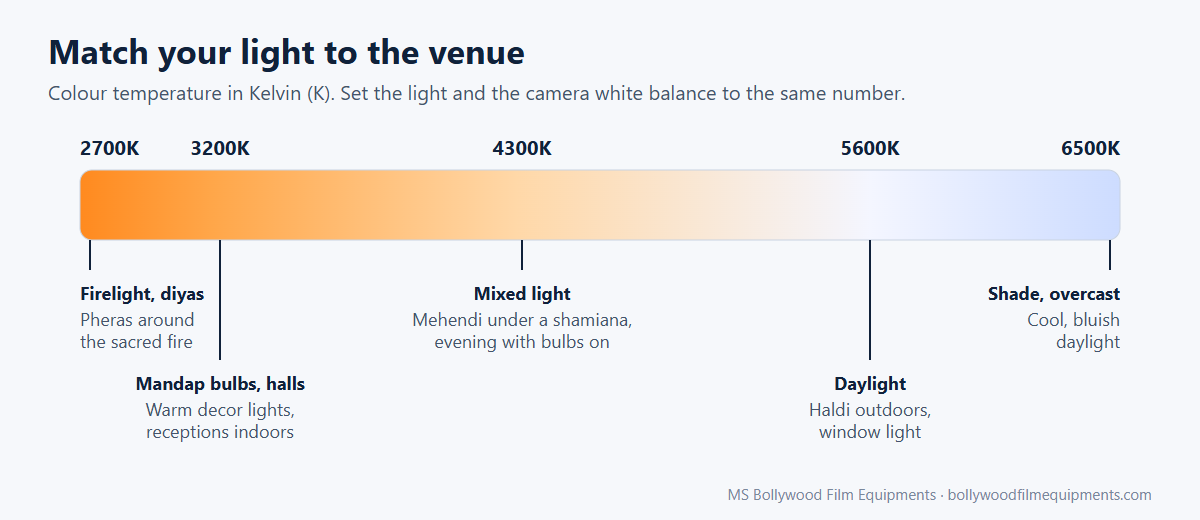
    Colour temperature scale from 2700K to 6500K for Indian weddings: firelight and diyas at 2700K, mandap bulbs and halls at 3200K, mixed light at 4300K, daylight for the haldi at 5600K, shade at 6500K
    Set the light and the camera white balance to the same Kelvin value.

    Which LED light is best for wedding video shooting?

    Look for these five things, in this order:

    • Colour accuracy of CRI 95 or higher. Skin tones, red lehengas and gold jewellery are where cheap LEDs fail first. Every light in this guide is rated CRI 95 or above.
    • Bi-colour control. 2700K to 6500K covers everything from firelight to noon sun.
    • Battery power. Venues rarely give you a free socket where you need it. Built-in batteries, NP-F or V-mount.
    • Flicker control. Some lights let you change their frequency so they don't flicker on camera at high shutter speeds.
    • Size. If it needs a second person to carry it, it will stay in the car.

    Good fits from our range

    Main light: Nanlite FC60B

    Nanlite FC60B Bi-Color LED Spotlight

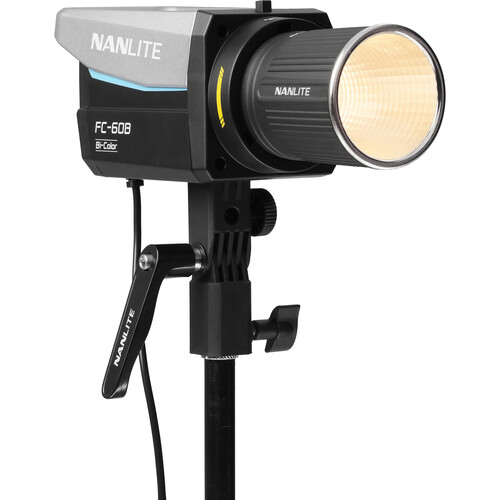
    The Nanlite FC60B Bi-Color LED Spotlight is a 60W bi-colour spotlight (2700-6500K, CRI 96) that comes with an NP-F battery grip and a Bowens adapter, so it runs without mains and takes a softbox. A strong main light for a two-person crew.

    Soft portraits and speeches: Amaran F21x

    Amaran F21x Bi-Color LED Mat (V-Mount 2 x 1)

    The Amaran F21x Bi-Color LED Mat is a 2×1 ft flexible LED mat (2500-7500K, CRI 95+) that folds into a bag and runs from a V-mount battery. It comes with its own softbox and grid, and gives very soft light for portraits and speeches.

    Fill and on-camera light: Amaran Ace 25x

    Amaran Ace 25x Bi-Color LED Light Panel All-in-One Creator Kit

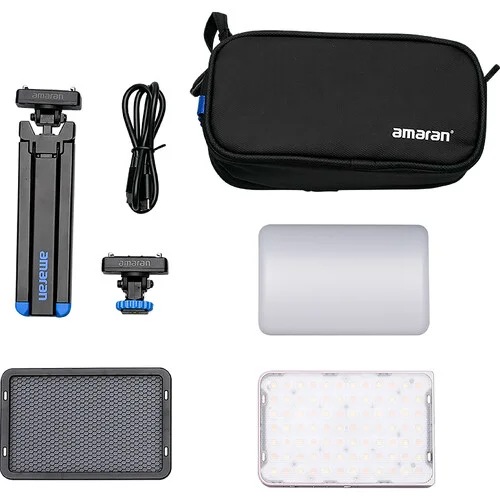
    The Amaran Ace 25x Bi-Color LED Panel Kit is a compact bi-colour panel (2300-6500K, CRI 95) with a built-in battery and USB-C charging. It goes on camera, in a second shooter's hand or on a mini tripod.

    Silent, weatherproof fill: Aputure MC Pro

    Aputure MC Pro RGBWW LED Light Panel

    The Aputure MC Pro is a pocket-sized RGBWW panel rated IP65 against dust and water, with passive (fan-free) cooling, so it makes no noise during vows. Good for the outdoor haldi and for hiding in a mandap.

    Sangeet and baraat: Godox LC500R Mini

    Godox LC500R Mini RGB LED Light Stick

    The Godox LC500R Mini RGB Light Stick is a 46 cm stick with bi-colour and full RGB, CRI 95, and a music mode that syncs to the beat. Made for sangeet stages and the baraat.

    Backlight and stage entries: Godox TL60 kit

    Godox TL60 Tube Light 2-Light Kit

    The Godox TL60 Tube Light 2-Light Kit has two RGB and bi-colour tubes (CRI 96) with about two hours of battery each. Good for backlighting the couple or lighting a stage entry.

    Two wedding lighting kits

    Starter kit: one shooter, small budget

    Job Product
    Key and fill Amaran Ace 25x Bi-Color LED Panel Kit
    Effects and baraat Godox LC500R Mini RGB Light Stick
    Sound on camera Godox VS-Mic Shotgun Microphone
    Stand KUPO Universal Stand 12' with air cushion

    Professional kit: two-person crew

    Job Product
    Main light Nanlite FC60B Bi-Color LED Spotlight
    Soft modifier for the main light Amaran Light Dome 60 (focused, soft) or Amaran Lantern 65 (soft all around, good for a mandap)
    Portraits and speeches Amaran F21x Bi-Color LED Mat
    Silent fill, outdoors and in the mandap Aputure MC Pro
    Backlight and stage effects Godox TL60 Tube Light 2-Light Kit
    Monitor for the second camera Lilliput A7S 7-inch monitor
    Sound Godox VDS-M1 Shotgun Microphone
    Stand KUPO Universal Stand 12' with air cushion

    For more options, see all our continuous lights, LED panels and softboxes. For how COB lights, panels, mats and tubes compare, with prices, see our guide to LED lights for film shooting.

    Wedding video light setup, step by step

    A setup that works for portraits, speeches and the mandap, and takes five minutes:

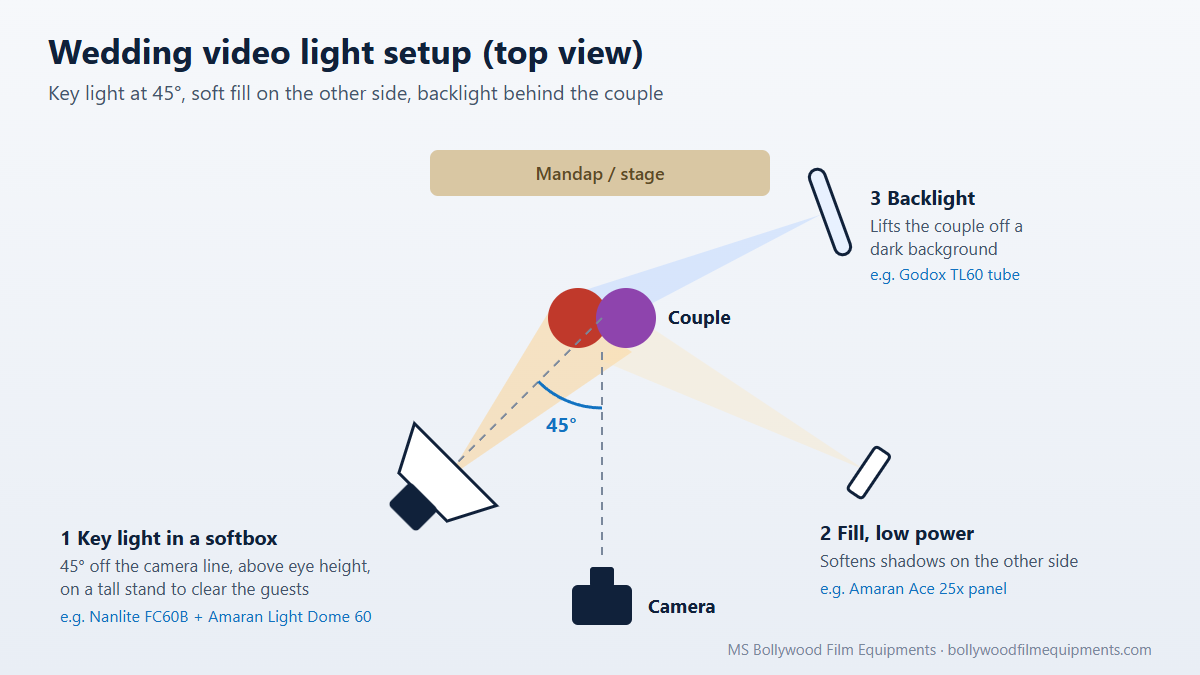
    Top-view diagram of a wedding video light setup: key light in a softbox at 45 degrees to the couple, a low-power fill light on the other side, and a tube backlight behind the couple, with the camera in front
    A three-light setup for portraits, speeches and the mandap.
    1. Find where the couple will be and where the camera will be. Everything else follows from those two points.
    2. Put the key light at 45 degrees to one side of the camera, a little above eye height, in its softbox. On a 12-foot stand you can clear the guests' heads.
    3. Match the colour to the room. Look at the venue's own lights. Warm bulbs and firelight: set the light around 3200K. Daylight through windows: 5600K. Then set the camera's white balance to the same number.
    4. Fill the other side gently with a small panel at low power, or let the venue's light do it.
    5. Add a backlight if there's time, a tube or stick behind the couple, to lift them off a dark background.
    6. Check faces on the monitor, not the camera screen, before the ceremony starts. You won't get a second chance at the pheras.

    Stopping flicker and colour problems at Indian venues

    • Mains power in India is 50 Hz. Venue LEDs and tube lights can flicker on camera. Shoot at a shutter speed of 1/50 or 1/100 to hide it, and use a light's frequency setting if it has one.
    • Don't mix warm and cool light on one face. If the stage is lit with cool white LEDs and your light is warm, one side of the face goes orange and the other blue. Match your light to the strongest light already on the subject.
    • Keep light out of the pandit's and the guests' eyes. Bounce or soften it, and keep it high. A harsh light in someone's face during a ritual will get switched off by the family.

    Which camera for wedding videography?

    A good light helps any camera, but for low light and long ceremonies these do the most. For a full comparison by budget, see our guide to the best camera for filmmaking under ₹1 lakh and ₹2 lakh.

    • Sony A7S III: a 12.1MP full-frame sensor built for low light, with 4K up to 120 fps. The standard for night baraats and dim halls.
    • Sony FX30: a Super 35 cinema camera with dual base ISO and a cooling fan for long recordings, useful when the pheras run for an hour.
    • Sony Alpha A7 IV: 33MP full frame with 4K up to 60 fps, for crews who shoot photos and video on one body.
    • Sony ZV-E10 II: an APS-C camera with 4K and Real-Time Eye AF, a sensible second camera or a first camera on a budget.

    Frequently asked questions

    Do I need RGB lights for wedding videos?

    Not for most of the day. Bi-colour white light covers portraits, rituals and speeches. RGB earns its place at the sangeet and for creative backlighting, so one small RGB light or stick is enough.

    How many lights do I need to shoot a wedding?

    Two or three. One main light in a softbox, one small fill panel, and one light for effects or backlight. More than that slows a two-person crew down.

    What colour temperature should I use for a mandap?

    Around 3200K, to match warm decor bulbs and firelight. Set the camera's white balance to the same value so skin tones stay natural.

    Can I shoot a whole wedding on battery power?

    Yes, with lights like the ones above that run on built-in, NP-F or V-mount batteries. Carry at least one spare battery per light for the evening functions.


    Want help putting a wedding kit together? Visit our store in Goregaon West, Mumbai, or send us a message on WhatsApp from any product page. Everything ships free across India, with a GST invoice for input credit.